
Sensing geometry
Shape the active region around the available contact area and load path.
FLEXIBLE SENSING COMPONENTS
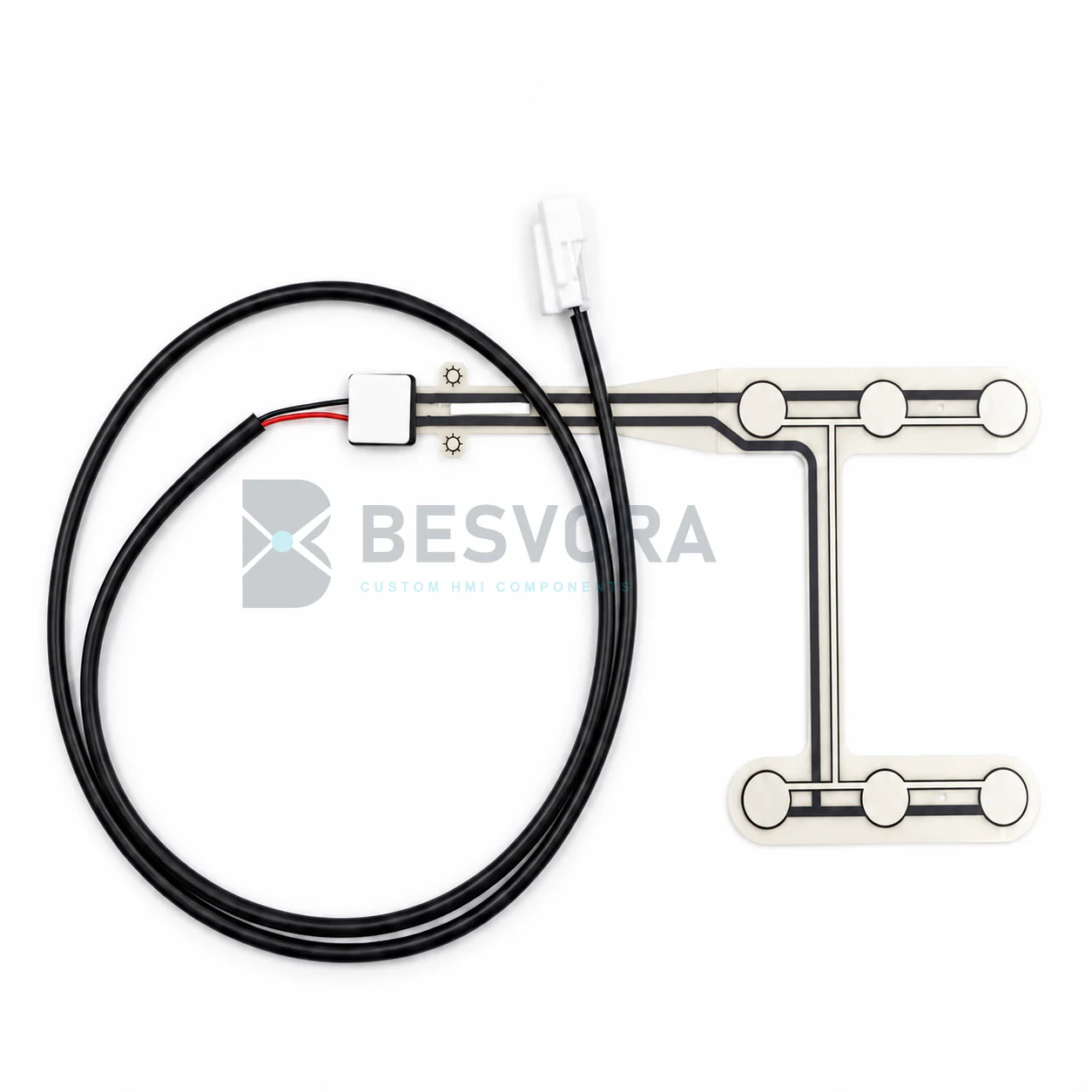
Develop a flexible sensing geometry around the contact zones, installation space, tail routing and response required by your application.
PRODUCT OVERVIEW
Force-sensing resistors change electrical resistance as force is applied. Their geometry can be adapted to the required contact areas, sensing zones, routing and equipment interface for presence, contact and relative force-change applications.
The sensor is one part of a complete measurement system. Mechanical loading, electronics, calibration logic and installation conditions all influence the final system response and need to be validated in the customer application.
FSR components should not be presented as calibrated precision load cells without system-level design and validation. Numerical response, range, repeatability and environmental performance remain project-specific.
STARTING INFORMATION
You do not need every answer before contacting us. Send what is available and the missing items can be identified during clarification.
What event or change the equipment needs to detect.
Where force is applied, the contact geometry and how the load reaches the sensor.
Target shape, dimensions, mounting area and tail-routing restrictions.
Readout approach, connection method and any existing circuit information.
APPLICATIONS
Suitability depends on the final construction, equipment interface and customer validation.
COMMON QUESTIONS
No. An FSR is commonly used for contact, presence and relative force-change sensing. Precision measurement requires the complete mechanical and electronic system to be designed and validated for that purpose.
Yes. Geometry and zone layout can be reviewed against the contact areas, routing and available installation space.
Share the detection objective, contact area, available dimensions, approximate loading method, connection requirements and any drawing or equipment photo.
DISCUSS YOUR PROJECT
Start with a short description of fsr sensors. Drawings or confidential files can be shared later through business email, WhatsApp or another agreed channel.